

Alcohol in India: A Bottle of Contradictions
Hello there.
You are reading another edition of the Mind of My Mind series — A broad investigation about Alcohol. In this episode we explore governance strategies around alcohol and create speculative scenarios.
The story of alcohol in India and how it slips between our laws, our festivals, our politics, and our personal lives is very interesting. The more I read, the more I realise that alcohol is a system that is, at once, regulated and lawless, celebrated and condemned, essential to government coffers yet destructive to public health. This is my attempt to walk through what I’ve found so far.
A Broad Glance
Alcohol is stitched into both our grief and our celebrations. It is a coping mechanism for stress, a social lubricant, a way to seek euphoria. Growing up, I remember how the presence of alcohol at weddings was so normalised that it hardly raised an eyebrow. Today, with media portrayals, peer pressure, and urban lifestyles, its use has only deepened.
“Bhai, it was never about taste. It was about numbing the day. First it was one quarter, then two. I thought I was controlling it, until it controlled me. The law says 18 or 21, but in my town, a kid can get a bottle faster than a glass of milk. Nobody asked my age.”
— Fictional person on an imaginary street in India.
The numbers tell their own story. According to the NFHS-5 report, 14.6% of people aged 10–75 consume alcohol in India—16 crore individuals. Among them, 23% are men, just 1% are women. But it’s not just the prevalence that worries me—it’s the intensity. India ranks among the highest in the world in heavy episodic drinking. The cost to society was estimated at Rs 6.24 trillion in 2021, with 3.7% of all deaths and 3.1% of DALYs linked directly to alcohol. These figures don’t even capture the unreported consumption of illicit liquor, which is common in many regions.
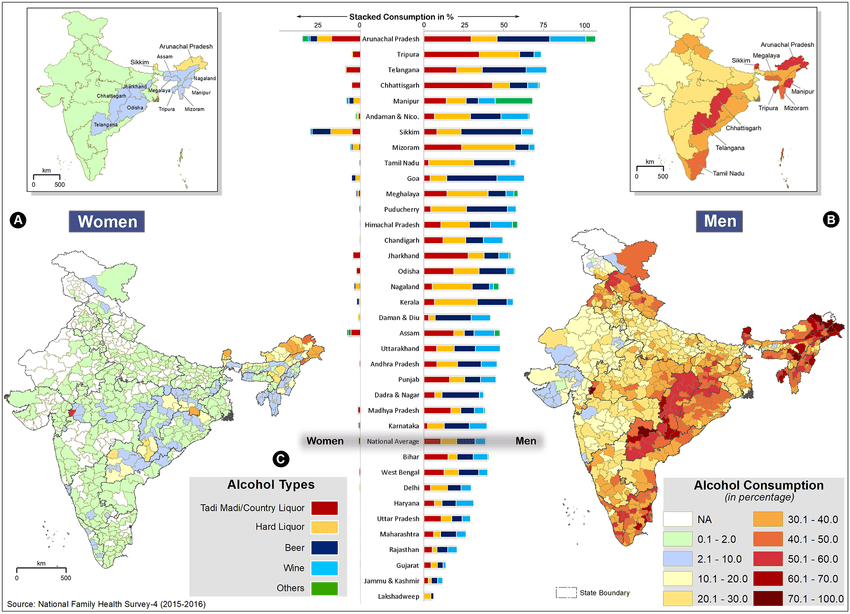
Per capita consumption has risen sharply over the past two decades—from 1.6 litres in 2003–05 to 5.5 litres in 2016–18. And while direct advertising of alcohol is banned, the industry has found a way through surrogate advertising, pre-mixed drinks, and flavoured spirits. You only need to look at how energy drink bottles or “club soda” ads are designed—they carry all the cues of alcohol marketing. It’s a strategy aimed squarely at younger crowds.
National Policies
Here’s the strange thing: India does not have a unified national alcohol policy. What we have instead are scattered efforts bundled under the broad category of drug prevention.
The Nasha Mukt Bharat Abhiyaan, launched in 2020 across 272 districts, tries to focus on preventive education, capacity building, and strengthening rehab services. The National Action Plan for Drug Demand Reduction (NAPDDR) takes a similar approach, aiming to reduce harm through awareness, counselling, treatment, and training. These programs are well-intentioned, but they sit on top of a legal framework that feels outdated. The Excise Act of 1944 still underpins regulation, while Article 47 of the Constitution recommends prohibition of intoxicants harmful to health. These remain more symbolic than binding.
When I read through these documents, what stood out to me was how much ambiguity there is. The laws are full of references to prohibition, but in practice, prohibition often exists only as a constitutional reminder rather than a functioning policy.
“On paper, sir, everything is strict. But you know, in practice… rules bend. During elections, truckloads move at night. Licenses are sometimes given more on ‘relationship’ than on merit. If you ask me, enforcement has always been less about health, more about revenue.”
— Fictional government offical who wants to stay annonymous from an imaginary office in India.
Health Services’ Response
The medical side of alcohol policy feels like a patchwork. The Central Sector Scheme of Assistance provides funds to NGOs for de-addiction services. The Drug De-addiction Program, coordinated by AIIMS, was one of the first major steps—establishing 122 centres linked to district hospitals and psychiatry departments. Later, the scheme was expanded to include Drug Treatment Centres.
“Most men who walk in don’t call themselves ‘addicts.’ They say, ‘Doctor saab, I just need to sleep better,’ or ‘Mujhe bas gussa control karna hai.’ Alcohol is woven into their struggles—family fights, debts, jobs lost. The policy talks about treatment, but the man in front of me? He just needs someone to listen first.”
— Fictional Doctor in an imaginary hospital in India.
The Indian Public Health Standards outline treatment protocols for Alcohol Use Disorders (AUDs), and Ayushman Bharat has even folded mental health and substance use into its Health and Wellness Centres. But these are guidelines more than mandates; their implementation varies widely. The only clear state-level example I could find was in Punjab, which in 2011 set standards for rehabilitation and counselling centres.
When I tried to see what community-level action looks like, I could only find one example, the Panchayats (Extension to the Scheduled Areas) Act, 1996. This law empowers village bodies in Scheduled Areas to regulate or even prohibit alcohol sales. Yet in all my searching, I didn’t come across any real-world stories of its use. It seems more like a possibility left on paper.
Reducing the Impact of Alcohol Intoxication
There was at least one clear national effort to address harm directly. The Food Safety and Standards (Alcoholic Beverages) Regulations, 2018 introduced rules around ingredient safety, labelling, and packaging. Every bottle must display its alcohol content and the number of standard drinks. Labels can’t suggest the drink is healthy or harmless. And each container must carry a warning, at least 3mm tall, cautioning that alcohol is injurious to health and warning against drinking and driving.
State Policies
Alcohol regulation ultimately belongs to the states, and this is where things get complicated. Some states—Bihar, Gujarat, Mizoram, Nagaland—enforce prohibition. Others impose partial restrictions. Meanwhile, in cities, alcohol is just a few taps away through apps like Swiggy or Zomato, which has normalised doorstep delivery in ways the laws haven’t caught up to.
This decentralisation sounds democratic, but in practice it creates confusion. Different states write their own excise acts, leading to loopholes, black markets, smuggling, and underage access. Governments also rely heavily on excise duty; alcohol brought in 2.25 trillion rupees in 2019–20, with 21 states earning more than 15% of their annual revenue from it. That kind of dependence makes regulation a double-edged sword: you can’t cut off a revenue stream that funds your budget, even if it harms your citizens.
“Customers always ask,‘Bhai, soda kaunsa free milega?’ Never once have they asked about the health warning on the label. Those warnings are too small, yaar. People don’t see policy; they see price and convenience.”
— Fictional staff of a wine store in India.
In Odisha, excise labels must include health warnings. In Tamil Nadu, the rule is only about polyester holograms. These inconsistencies might sound trivial, but they show how fragmented the system really is.
Advertising and Alcohol
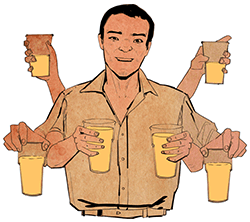
One of the most striking loopholes is in the advertising laws. The Cable Television Network Rules allow alcohol brand names to be used in promotions. Companies exploit this with surrogate advertising, launching “club sodas,” bottled water, or music festivals that carry all the cues of liquor branding. Sponsorship of cricket teams or influencers on Instagram amplify this. I’ve seen teenagers in my own circles treat alcohol-branded soda ads as aspirational markers, even when they know the soda itself is irrelevant. This is how young people are hooked, long before they’re legally old enough to buy.
Conclusion
The deeper I go, the more it feels like alcohol policy in India is less about public health and more about managing contradictions. We have laws, but their enforcement is patchy. Minimum drinking age, drunk driving rules, illicit liquor, none of these are consistently policed. Prohibition creates smuggling and bootlegging; regulation creates revenue dependence. Somewhere in between, public health falls through the cracks.
There is also a worrying silence; policy documents rarely acknowledge alcohol’s role in domestic violence, mental illness, or household debt. Enforcement is tangled in corruption, liquor distributed during elections, licences granted through bribes (allegedly), excise rules bent at will. On the ground, the law often looks like an open secret.
What If We…
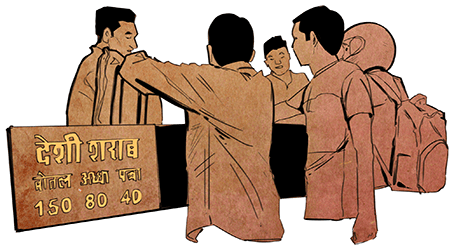
So I started to think in questions. What if excise revenues were earmarked for public health and rehab programs, with transparent tracking? What if we banned surrogate advertising altogether and cracked down on alcohol marketing online? What if alcohol came in plain packages, like tobacco, with large warnings and no glossy branding?
What if schools taught conscious consumption, not just abstinence? What if technology was used to monitor smuggling across state borders or to detect underage digital targeting? And above all, what if we had a National Alcohol Control Policy—a framework that prioritised health over revenue, prevention over punishment?
While all that said, there are more questions than answers, but also with the sense that we could do better. Alcohol in India is not just a drink, it’s a mirror of our contradictions — our need for revenue, our appetite for escape, our neglect of public health, and our ability to look away.
Speculating on Futures
Based on these ‘what if’ scenarios I created more humane, integrated, and systems-oriented response to alcohol-related harms. These go beyond existing measures and imagine future departments, restructured governance, and innovative public health interventions grounded in Indian realities.
Ministry of Psycho-Social Health & Dependency Recovery (MoPHDR)
A new central ministry that focuses not only on addiction but on the social and psychological roots of dependency — including alcohol, gambling, digital addiction, and pharmaceutical abuse. The ministry brings together psychiatrists, anthropologists, artists, and local community workers to design recovery ecosystems, not just clinics.
Local Panchayat-led Harm Reduction Councils
Each village or ward-level panchayat runs a harm reduction council made up of local residents, peer counsellors, youth leaders, and one state liaison officer. They monitor home-brew practices, track underage access, and coordinate non-policing responses to addiction — like employment support and family mediation.
Excise Revenue Redistribution Board
A transparent, citizen-auditable body that redirects alcohol excise revenue into health and educational funds. Every bottle sold contributes a micro-tax, visible on the receipt, which feeds into a public dashboard. Citizens can vote on local allocation — mental health services, de-addiction clinics, or harm reduction campaigns.
National Registry of Alcohol-Linked Health Outcomes (NRAHO)
A public health data system that anonymously tracks alcohol-related hospitalizations, liver diseases, domestic violence complaints, and workplace injuries. Allows for real-time mapping of alcohol harm hotspots, so interventions can be hyper-localized and proactive rather than reactive.
Public Interest Alcohol Design Lab (PIAD-Lab)
A government-supported innovation lab where designers, behavioural economists, and media workers collaborate on campaigns, packaging reforms, alternative social rituals, and new forms of non-alcoholic hospitality that de-normalize alcohol without demonizing users.
Algorithmic Wellness Regulation Authority (AWRA)
A tech regulatory body that monitors how alcohol is promoted online — through influencers, platform algorithms, surrogate marketing, and AI-generated content. Think of it as the Tobacco Board for the digital era — flagging harmful content and redirecting youth attention toward safer narratives.
Department of Future Generations
A constitutional office that advocates for policies affecting unborn generations. In alcohol policy, this department intervenes on prenatal exposure, youth marketing, long-term public health planning, and intergenerational trauma linked to alcohol abuse.
Rehabilitation Through Work (RTW) Urban Missions
Every major city has an RTW office that partners with small businesses, municipalities, and cooperatives to offer structured part-time employment to recovering users—especially those released from detox or rehab centres. This creates economic dignity alongside sobriety.
The School of Conscious Consumption
A public education project integrated into the CBSE/State Board curriculum from Class 6 onward. Teaches students about alcohol, media influence, stress coping, impulse control, and pleasure without dependency. Includes parent modules and local storytelling formats to keep it culturally rooted.
Annual National Report on Alcohol Harm (with Citizen Contributions)
An open-source report issued every year by a coalition of ministries, researchers, NGOs, and recovered users. Includes ground reports, case studies, poetry, medical data, and regional updates. Helps shift the conversation from numbers to narratives, and invites public ownership of the problem.
—
Breathe 🙂
Yuvraj Jha.
Concept Artist. Worldbuilder. Storyteller.
Insta – @monkeyverse | Youtube – @monkeyverse_in
Shop – bandarchaap.com | Insta – @bandar.chhaap
4 Comments
Comments are closed.
Pingback: Worldbuilding with Speculative Policies – Monkeyverse